What to Aim For When You Swing

Here’s another brilliant idea that might help you, or maybe not, but try it out anyway.

When we swing a golf club at nothing we make a flawless swing. When we swing at a golf ball, well, that’s a different story, isn’t it? The ball makes us do crazy things and we just can’t help ourselves.

Here’s this week’s expert advice guaranteed to solve that problem. Don’t look at the ball when you’re swinging to hit it. Look somewhere else.

If you’re hitting an iron from the fairway, you know you’re trying to hit ball first, ground second. So be looking at a spot perhaps an inch in front of the ball. Hit that spot with the leading edge of your iron and you will make outstanding contact.

Fairway wood? Same thing. Look at a spot on the ground an inch or so ahead of the ball. There’s a trick to it, though.

When you swing the club back, it’s a fairway wood. You’re looking at it. You can’t deny it. But just before you swing the club forward, think “7-iron,” and swing forward to hit that spot with the much sharper edge of your “7-iron.”

Works like a charm.

What about balls on tees? Be looking at the spot where the club would hit the ground were the ball not on a tee, and that is about an inch behind the ball.

Pitches and chips are a bit different. In these shots, you slide the sole of the club across the top of the grass. So look at the ground underneath the ball. It takes a little imagination to focus on the ground under the ball without noticing the ball, but you can teach yourself to do it.

Looking at a different spot does two things: it stops you from being ball-bound, and it helps you aim your stroke to where it should be aimed.

No beating down on the ball! And remember, swing with good rhythm and let the handle lead the clubhead.

Those Extra Strokes

When you play 18 holes, you know you’re going to putt the ball into the hole 18 times. The structure of par assumes you need 36 strokes to get the ball on the green in 18 holes. That’s 54 strokes, guaranteed, every time you play.

The questions you need to answer are, what are you doing with the shots from #55 up to your average score? And which of them you can get rid of most easily?

Extra putts? Of course there are going to be some. But if there are more than 18 extra, that’s too many. An extra 14 would be nice.

Extra swings? Make good contact and hit the ball straight. This isn’t difficult if you get lessons to learn what you’re supposed to be doing. Hint: it might take more than one lesson.

Penalty strokes? Keep the ball in bounds and out of water hazards. See above.

Extra recovery shots? Hitting out of tall grass, hitting out of trees, all that’s going to happen, so learn to get out of trouble and back in play in ONE shot. Don’t get greedy.

Extra chips? One per hole. First chip gets on the green. Close to the hole is better.

Extra pitches? One per hole. The green is a HUGE target. But if you aren’t good enough yet to hit it on the fly every time, hit a pitch and run with an 8-iron. Even if you can hit it on the fly, if the pin is sitting right in front of you and there is good ground between it and you, go with the 8-iron.

Extra sand shots? The pros say this is the easiest shot in golf. It is, but it’s a lot like learning to ride a bicycle. Get a lesson and practice. Once you know how to do it, it’s the easiest shot in golf.

Winter golf practice, 2017-18

1. This winter, go to the range twice a week. Get a small bucket. Hit half the balls with a full swing, and use the other half for pitches from 50-100 yards. It’s likely that the balls will be cold and not go as far as you expect. All that (~30 shots) should take about 15 minutes. Spend 45 minutes on the practice green hitting chips and approach putts. Practice short putts at home.

2. Get a lesson to find out how to put the ball in the fairway off the tee if this is a problem for you. If you normally hit less than ten of fourteen fairways, it’s a problem.

Try Two Putters

You carry a driver and a fairway wood or two, maybe a few hybrid irons, six or so irons, a few wedges—and one putter.

Why only one putter? Well, up to the green, we need all those clubs because all the shots we need to play are different. But once we get the ball on the putting green, all the strokes are the same, aren’t they?

They are certainly not!

There are two kinds of putts. There are the long ones that you only want to get close to the hole, and there are the short ones you think you can sink.

You not only plan each kind of putt differently, if you examine your putting carefully, you will find that you hit them differently, too. That is why you need two putters.

They need to be putters with a difference. Any old two won’t do. The difference has to do with balance.

If you balance your putter shaft on your hand, you will probably see that the shaft rotates so the toe of the putter points to the ground. If so, you’re holding a toe-balanced putter (bottom in photo).

But there is another kind of putter which, if you apply the same test, ends up with the toe of the putter pointing straight to the side and the face facing the sky. This is a face-balanced putter (top in photo).

You might have read about whether your putting stroke should take the putter back on a straight line or on an arc. There are proponents of both schools.

The fact is, a toe-balanced putter naturally swings on an arc, and a face-balanced putter naturally swings straight. So you don’t have do to do anything. Just pick the right putter and use your normal putting stroke to get one result or the other.

Now, here’s the point. Approach putts hit from a distance need power supplied by an arcing stroke which allows us to move freely as our bodies are built to. That calls for a toe-balanced putter.

Short putts, where direction is paramount, are better struck with a shorter stroke that stays on line from start to finish, which gives greater assurance to the putter face being square to the starting line when the ball is hit. Enter the face-balanced putter.

So if I told you all you have do to save three shots per round is to take out one club (probably one of your longer clubs) and put in a second putter, would you do it? I did, and that’s why I’m writing this post.

A Flexible Body for Golfers

A few years ago I wrote a post showing five exercises designed to strengthen the core in order to play better and prevent injury.

Flexibility is a big part of an efficient and healthy golf swing, too. Here are five exercises that will keep you limber for golf.

1. Lateral bend — Stand with your feet apart. Bend to the side as shown, supporting yourself with a hand on the leg. Reach over your head with the other arm to complete the stretch.

lateral bend stretch

2. Supine trunk rotation — Lie down on your back and bring your knees up, feet flat on the ground. Rotate your knees to one side, keeping your shoulders in contact with the ground. This the preferred way to rotate the trunk. Rotating the trunk while standing adds compression force to the torque. When you lie down, there is no compression, only torque.

A different way to do this stretch is to start lying on your side with your knees bent, untwisted, with your arms straight in front of you on the ground. Slowly move your top arm away from your other arm toward the floor on the other side as you rotate your trunk, to arrive in the position shown.

supine trunk rotation

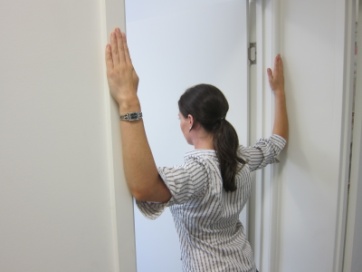
3. Rotator cuff — (1) Bring one arm across your body at shoulder level. Use the other forearm to press inward and complete the stretch. (2) Stand in a doorway with both hands on the doorway as shown. Lean forward for the stretch.

rotator cuff stretch 1

rotator cuff stretch 2

4. Hamstring stretch — Sit on the floor with one leg straight out in front of you. If you can’t tuck your other leg as shown, that’s all right. Lean forward (not down) to complete the stretch.

hamstring stretch

5. Neck stretch — Rotate the head to the left and hold for a few seconds. Do the same to the right side.

neck stretch

You can do all these stretches daily in less than five minutes.

We Visit the U. S. Senior Women’s Amateur

The U.S. Senior Women’s Amateur is being played in Portland this week. The final match is scheduled to begin in less than an hour from this posting.

I went to see it yesterday with one of my golfing buddies. The tournament is being played at the Waverly Country Club, a private course located in SE Portland on the east bank of the Willamette River.

It’s one of those clubs that you can’t just pay the membership fee and first month’s dues and you’re set to go. Rather, if they want you to be member, they’ll let you know.

So I figured the only way I would ever get to prowl the grounds is if there was a tournament there. Fortunately, the USGA likes this course. They sometimes have local qualifying for the U.S. Open on it.

Fairways are narrow (the word “ribbon” comes to mind and is accurate), there are numerous deep bunkers, the lay of the land is hilly–level lies in the fairway are hard to find, and the greens–ridges, slopes, you could get seasick walking on them.

We saw the morning quarterfinal matches, and I swear we were the only people out there who were not relatives of the competitors or involved in some way with the tournament. Only four groups on the entire course.

And it was quiet. Real quiet. Just golf balls being hit. No talking. All business.

We saw some outstanding shots, and some beaner shots. But this we did see: straight shots. Maybe off line sometimes, but straight flight. Balls coming into the green right at the pin. Short game OK, putting outstanding.

The players took their time picking their shot, but once they had it, it was get the club, set up, and swing, all in a rhythm oozing confidence and competence.

Every one of the eight players had a swing that was flowing, graceful, smooth, and to the point. And without an ounce of “hit.” It was all swing, and that’s my biggest golfing takeaway from the day.

When the morning matches were over, we left and had lunch nearby. I had a cup of curried corn soup and a summer risotto. Then home. What an outing.

How Not to Drive Yourself Nuts on the Golf Course

From my forthcoming book, Bob’s Living Golf Book:

1. Hit an easy shot with a simple outcome. Don’t make any shot a big deal. Just get an idea, and hit the ball with no worries.

Then,
2. After you hit this one, don’t think about it, good or bad, and don’t think about the next one until you’ve arrived at the ball. Spend the meantime schmoozing with your buddies.

When you get to your ball,
Go to step 1.

3. Add up your score when the round is over. While you’re playing, it’s not important.

Fix It Yourself

There was a time not too long ago that my driver was my go-to club. I felt as good about hitting it into a narrow fairway as I did standing over a 6-inch putt on a slow green. But because of my health issues I haven’t played that much in the last five years and and I lost that swing.

So now I’m trying to simplify my swing to to make it easy to perform and easy to remember. Though I hit my irons okay, I hit one duck hook after another with my driver. The ball lands about 120 yards away then rolls into the left rough. You can’t play golf like that.

I changed my grip. That didn’t help. I change my takeaway. That didn’t help. I worked on my turn to square up the clubface. That didn’t help.

One of the things I had done to simplify my swing was to start the swing by pulling the club back with my right hand. I figured pulling something moves it more accurately than pushing it. So I pulled the club back with my right hand rather than pushing back with my left.

That, it turned out, was the problem. It was in the takeaway, but I had been looking in the wrong place.

Two days ago I decided to find out where in my swing my clubface was closing because that is what was causing those duck hooks. Every place I checked the clubface was closed. It got to the point where I saw my clubface had closed no more than two feet after it had been taken away from the ball. And then the solution hit me.

By pulling the club away with my right hand I was not allowing the club to rotate open. I was closing the club face from the very start. Try it and you’ll see what I mean.

So I tried doing the opposite and started the club back by gently pushing with my left hand. Problem solved.

The club face remained square and I began hitting drives just like I used to. Straight, up in air, and while maybe not as far as before, the ball still got out there.

I’m telling you this because sometimes it doesn’t take a wholesale change in your swing to correct the problem you’re having. If you just spend time investigating your swing in detail you can find out what the problem is. And if you don’t find it, keep looking.

I have always recommended lessons, but much more often you can figure out what the problem is and find the solution yourself. When your golf is based on knowledge that comes from you, that’s one step closer to owning your swing.

End-Gaining

I will be posting my next opus, Bob’s Living Golf Book, in a few weeks. Here’s an excerpt:

End-Gaining
When golfers begin thinking that the purpose of the golf swing is to hit the golf ball, they have become an end-gainer. That means trying for a result directly rather than following the best way to achieve that result.

For example, at the range you have just hit an unsatisfactory shot so you try a little tweak you think will let you hit a better shot, or at least avoid the bad one. But that doesn’t work so you try another tweak, and so on, leading yourself farther away from the desired end rather than closer. This is end-gaining.

The end-gainer keeps doing what feels right, but which is functionally wrong, instead of doing what is functionally right, but which, because of lifelong habits, feels wrong. Even though we might know intellectually what we should be doing, the familiarity of habit forces us into the same mistakes again and again in spite of ourselves, or, more to the point, because of ourselves. In all those corrections you made to hit a better shot you might have thought you were doing something different, but you were most likely repeating variations of the same mistake.

The solution to this problem is, first of all, to find out what is right. Then proceed from the beginning of a movement until just before the part that needs changing is reached. At that point, stop. Do not let a response occur that leads from there to the wrong feeling, and thus to the wrong movement. Do this many times, until the response to proceed incorrectly has disappeared. At that point you may now insert the correct movement and start teaching yourself the correct response, which has a new feeling that you must learn to be comfortable with.

The insidious habit of end-gaining is what makes golf difficult, and prevents golfers from improving. Whenever your shotmaking, whether drive or putt or in between, is not satisfactory, end-gaining is most likely the cause.

Golf Research

If you start poking around on the Internet, you can find fascinating articles about golf that are not written by golf experts like me, or teaching pros who do the best they can.

I mean articles published in academic journals investigating golf to find out what is really true and what is just inherited wisdom. You might have some fun with this list of articles. I do.

These papers are written in a standard format. I suggest you read the abstract, introduction, discussion, conclusion, and that you browse the references to find articles that might interest you on this subject. The section on methodology is of no concern unless you want to evaluate the study or reproduce it, and the analysis can be quite technical.

Is Tiger Woods Loss Averse?

Work and Power Analysis of the Golf Swing

The lumbar spine and low back pain in golf: a literature review of swing biomechanics and injury prevention

Assessing Golf Performance Using Golfmetrics

Equitable Handicapping in Golf

Training in Timing Improves Accuracy in Golf

(These articles were accessed in August 2017.)

Start poking round yourself. Go here and enter keywords that interest you. You will be amazed at what you find.

Little Differences That Make a Big Difference in How Well You Play