Category Archives: golf swing

Keeping the Clubface Square

Keeping the clubface square depends a lot on your particular swing, so I can’t provide a complete and universal solution to the problem.

I can identify four places where you can get the clubface out of square that do apply, regardless of how you swing the club.

Grip. Use the grip that conforms to how your forearms are structured. See A Basic Golf Swing. If your grip isn’t right, nothing else matters.

Takeaway. The first foot you move your hands away from address is a danger zone, where it is so easy to get your clubface out of square that you will never notice you have done it. You think it must be happening somewhere late in the backswing, but it happened at the very start. If you get your clubface out of square consistently, check that it might be happening here.

Transition. When you start the club back down to the ball, if you try to hit with your hands from from up there, an easy mistake to make, there goes the clubface.

Just before impact. The urge to hit the ball, instead of swinging through it, makes you barrel into the ball with your right hand (left hand, for lefties). There goes the clubface.

My Golf Swing Reference Video

This is a video of my golf swing, taken in 2010 when I was playing 9-handicap golf. I watch it regularly to remind myself of what my personal swing is, because like so many golfers I drift occasionally, and I need to know where to get back to. Best to watch it with the sound turned off.

These are the things that define this swing for me.

First comes swing speed. This swing takes about 1:18 seconds from takeaway to impact. That’s not very fast, but this is the speed that makes sense to me while holding the swing together.

At the end of the backswing my shoulders have turned less than 90°. I could turn them more, but my swing sense says this is far enough. At the start of the forward swing, my hips do not turn ahead of my arms. Everything turns together.

Both of these are back-saving moves. I had back surgery in 1971, so I needed to have a swing that put the least stress on my lower back. I had two more in 2012 so the need now is even greater.

My head turns but does not move from side to side. This is a point of disagreement. Some teachers and pros say it is alright to let it move back in the backswing, while others say keep it in place. While both methods work, what I do is what feels right to me. I also get one less moving part to maintain.

Notice the rhythm of the swing. This is important. There is no pause in the middle. The first half of the swing flows neatly into the second half as if it were all just one movement, which I feel that the golf swing is.

There are other things that a swing analyst could comment on, but the only things that matter to me in re-creating this swing are what I explained above.

Do something like this for your swing. Make a video of it when you’re playing well. It will be the biggest favor you ever did for your golfing self because believe me, one day you will be glad you have it to look at.

Basic Swing Skills

You need four skills to have a working golf swing:

1. A swing that keeps the clubface square up to the top of the backswing.
2. A swing that starts forward without over-accelerating the club.
3. A pivot that coordinates the turning of the body with the swinging of the arms.
4. A swing swings the club through the ball with a ball-first-ground second impact.

1. The right grip is vital for this, and it must be personalized. See A Basic Golf Swing (video) to learn how to get yours. After you have that, learn what it feels like to swing back with the clubface staying square to the swing path all the way back.

2. Pause at the top for the barest moment. Start down as slowly as you swung up. Think you are going to swing through the ball in slow motion. This thought will not slow you down. It prevents you from speeding up.

3. In the forward swing, everything is turning and flowing through the ball toward the target, from the very start in coordinated way. The forward swing must feel like it is one movement, not a collection of separate movements working together. And the club, especially the club, is included in this unified feeling.

4. Do not think of hitting at the ball, but swinging through it. Your forward swing up to this point has been a flow. Continue that feeling through the ball to the finish.

Notes on Nelly Korda

Everybody knows that Nelly Korda’s swing makes her one of the best ball-stikers in the world. PGA Tour pros who played with her last year couldn’t figure out why she doesn’t win every week.

Although she is the midst of doing just that lately.

Unfortunately, I can’t make the image bigger. Magnify your browser window to get a good look.

I’m showing you this video for only one reason–to show you how simple the golf swing really is. Swing the club back, turn your hips, and swing through the ball.

From there, watch it as often as you want and draw your own conclusions.

Timing the Golf Swing

In the golf swing, the hips turn and the arms swing. In the backswing, the arms swing back first and the hips follow. In the forward swing, the hips turn first and the arms follow.

When the rhythm and tempo of the swing are correct, each of those movements happen at the right moment and have the chance they need to develop fully.

When that is the case, we say the swing is correctly timed.

Rhythm is the relative duration of the backswing to the forward swing. Tempo is the overall speed of the swing, measured by how long it takes in total.

Rhythm, as explained in part 1 here, is the same for all golfers. Tempo is an individual characteristic, which depends on athleticism, flexibility, and strength.

Good timing is a consequence of proper rhythm and tempo.

What does is mean for the arm and hip movements to develop fully?

For the arms, it means for them to reach a consistent finished backswing position. For the hips, it means turn to the extent that they are slightly open at impact.

The evidence of good timing is clean contact on the center of the clubface. Granted, there is more to that than good timing, but you will get more out of good timing and so-so technique than good technique and a mis-timed swing.

To get good timing, you must give up the idea of hitting the ball as far as you can with the club in your hand, and instead hitting it as accurately as you can with that club.

The key to all this is in large part not rushing the arms at the start of the forward swing. Let the hip turn carry them until the momentum of the turning action releases their swinging action.

And swing through the ball. Don’t try to clobber it at the last moment.

Six Fundamentals Revisted

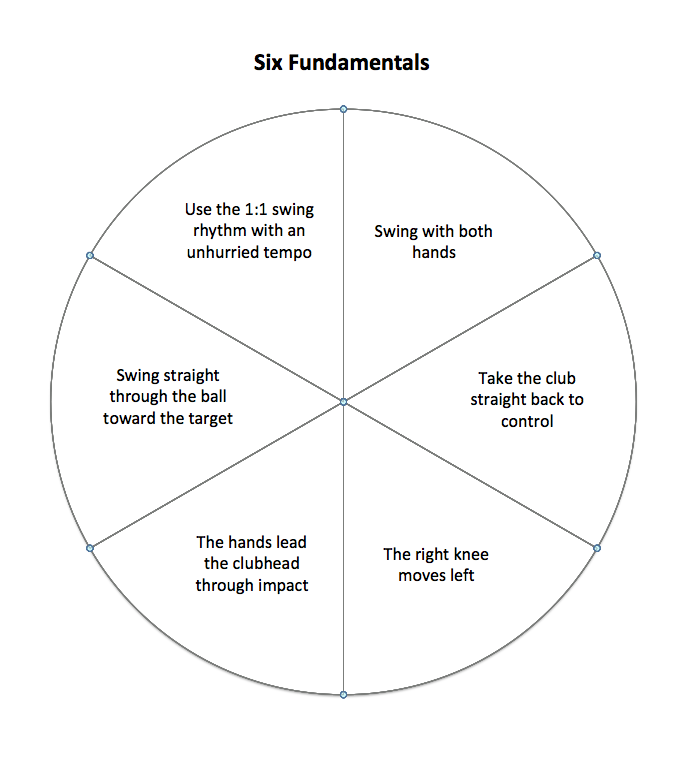
In 2014, I published a multi-media essay titled Six Fundamentals of the Recreational Golf Swing. Ten years later (where does the time go?) I still refer to them to make sure they are still present.

But you know that the golf swing doesn’t boil itself down to just six things. There’s a lot more to it than that. The problem is, you can take on only so much at one time. Even six is a lot.

So you, or I, don’t have to hold all those things in our head, lest we forget what it is we’re forgetting, I made a pie chart showing what they are, in a rough sequence, going clockwise. I used to take a print of it to the range to remind myself of what I was there to work on.

Here it is:
I’m now working of a new list of six things. There is some overlap with the old list, to be sure. The new list contains things I know are correct but I forget to do because of old habits.

This is my new list:

Forearms together – You want to have a feeling of connection between your forearms at address, and maintain that feeling throughout the swing. Ben Hogan and Mickey Wright said this was one of the most important aspects of their swing technique, and they are right.

Clubface square at the top – This is accomplished by keeping rotation completely out of your forearms. You have to train your hands to feel this, because that is where the rotation, if any, will be felt, especially in your right hand (left hand for port-siders). Remember, your hands are where you sense rotation. They are not what prevent rotation.

Complete the backswing – Don’t make your backswing too short. Let it come to a comfortable, relaxed ending. Feel like the club comes to a natural stop that suggests a rhythmic response to initiate the forward swing.

The hip turn starts the forward swing – And that response is for the hips to turn. The arms do not swing forward until the momentum of the hip turn impels them to.

Do not rush the start of the forward swing – Critical, critical, critical. Do not whip your hips around, do not throw your arms into the ball. Let them flow sequentially in a graceful way.

Use a tempo that allows everything to happen on time – If you move faster than you can manage, your technique will get into playing catch-up, and movements will always be late. If your swing is too slow… Ever seen a swing that was too slow? Neither have I. Never mind that one.

Now so you can make you own chart to remember the swing bits you are working on, download this Excel file. Then:

1. Overwrite the descriptions you see with a brief description of each bit you are working on. The text is in text boxes. Try not to move them around. Express your bit in ten words or less. Five words would be better.

2. When you’re looking at the chart, the lines making the circle and wedges might not show up very clearly, if at all. They’re there. Click once inside the pie chart (but not in a text box), and the lines should appear.

3. Make a screenshot of the frame and chart. This is easy to do on my Mac.* Press Command+Shift+4. A little cross and circle will appear on the screen. Move it with your mouse to the upper left of the frame. Now left click and drag the thinger to the lower right of the frame and release the mouse. A screen shot will be taken and put on your desktop. If you have a PC, taking a screenshot is more complicated, so look up how to do it on the web.

4. Now you can print the screenshot and take it with you to the range. Or when you make practice swings in your house.

In conclusion: Just as you cannot boil the golf swing down into six principles, neither can you boil it down to twelve. I do, however, recommend you consider installing my new list into your swing if you haven’t already done so.

And yet, they might not be the principles you need to turn your swing into what you want it to be. They are what make MY swing work. You have to discover your own.

*I know what you’re thinking. I have Microsoft Office for Mac installed on my iMac.

I’m Hitting Lots of Wedges

It has been quite lately on the blog. I haven’t been playing because it is so wet out here, but I have been practicing in my back yard between showers.

My practice is solely hitting wedges. Chips, half wedges, and occasionally a full wedge. What I am aiming for is perfect contact and hitting the straight at my target.

I’ve been hitting over 100 balls a day, those little golf-ball sized plastic balls that we called holey balls because they have holes in them.

This is what I have learned so far.

Consistent contact comes from controlling the swing with the hip turn. An arm swing is a crap shoot, and focusing on your hands is even worse.

Now the way I’m turning my hips and when, and what it feels like, is something I cannot describe it at all. It just came out of hitting more than 1,000 golf balls, and it’s easy for me to do the same way time after time.

A second thing is that you can only make that perfect contact when your grip is relaxed. I don’t want to say light, as in pressure. Relaxed is better because to relax your grip, everything else has to be relaxed, too, which is all to the good.

As for direction, aim is important, but not the whole story. You must have a idea of what path you want the clubhead to be following after the ball has been struck, and that path is straight at the target.

I find a spot on the ground about three inches in front of the ball along the target line, and telling myself to swing the club squarely along that line and over that spot. From there, it’s a subconscious mind thing.

I think I have a workable solution to those two problems. Now all I have to do is hit a few thousand more balls to make it automatic.

Then there’s distance. I’m saving that for last because there is no point is calibrating distances before the stroke is good enough.

Every now and then I swing a 6-iron, once, using the full wedge swing to see what happens. The same thing happens: perfect contact, ball goes toward the target.

As for all this practice, see this post, probably the most valuable on in the entire blog, and this one, quoting Broadway composer Stephen Sondheim.

How to Keep the Clubface Square

The key to hitting the ball straight (without curvature) is to keep the clubface square to the swing path.

There are three places in the swing where the clubface needs to be square: at address, at the end of the backswing,* and at impact.

Address. Step behind the ball, looking downrange. Visualize a line connecting the target and the ball. When taking your stance, place the club on the ground so the leading edge of its sole is perpendicular to the line.

Backswing. Swing back as far as you normally do, and stop. Remain coiled, and test the position of the clubface by lowering your arms straight down from where they are, to just above hip height. Turn your head to look at the clubhead.

If the leading edge of the sole is straight up and down, it’s square.** There’s nothing more for you to do but practice the feeling of that backswing over and over to make it your own.

If the leading edge leans either forward or backward a bit, this is the result of what feels normal to you, and you now have some work to do to replace your customary backswing feeling with one that keeps the clubface square.

The solution is in your hands and forearms.

Let’s say your clubface was closed. Swing back and rotate your forearms slightly clockwise as you do. Not too much. Just a bit. When your backswing is completed, perform the test. You can see right away if you got it right, if you went too far, or not far enough.

If you’re corrcting an open clubface, rotate your forearms slightly counter-clockwise.

Keep working until you get it right. Then remember what that backswing feels like and practice it over and over.

Identify a key feeling, too. What I have found is that when I am keeping the clubface square all the way back, the feeling of my hands on the handle that I have at address does not change. The feeling that clicks for you might be different.

Impact. You’ll need to hit golf balls to figure this one out. If your shots fly to where you are aimed, go out and break 80.

If they curve,*** or if they fly straight, but to the right (push) or left (pull) of where you are aimed, get a lesson to find out what you need to correct. Those errors can’t be fixed by reading a blog post.

* It is possible to play good golf from an open position or a closed position at the end of the backswing, but it so much easier to play from square.

** If you try this test when you have taken the club back only halfway, to hip height, a square leading edge will be leaning forward a bit. Performing this test from a different position gives you a different result.

*** To an unplayable degree.

The Relaxed Arms Golf Swing

All golf shots, from drive to putt, are made with the arms. The body provides support for the arms, but it is the arms that swing the club, not the body. The arms must be completely relaxed to do their best job. This lets the arm swing be a true swing, and not a hit.

Stand up straight and bend forward just enough so your arms dangle down in front of you. Now swing them from side to side, loosely, effortlessly. Notice how relaxed they feel. Notice also how relaxed your shoulder joints feel. Keeping your shoulder joints relaxed is what keeps your arms relaxed.

You might think this is all right for putting, because no power is needed in that stroke. But it’s the same for a drive. You don’t need power in your driver swing. You need speed. Speed comes from relaxation. Tense muscles feel powerful, but they slow down movement.

In all the different types of golf strokes, it is a given that the arms and shoulder joints should be completely relaxed throughout the stroke.