All posts by recgolfer

A New Look at Rhythm and Tempo

The marriage of rhythm and tempo is the foundation of the golf swing. If this part isn’t right, nothing else matters.

Rhythm is the relative duration of different parts of the swing. Tempo refers to the overall duration of the swing.

The rhythm and tempo that suit your golf swing are personal matters, to be determined by yourself for you alone, by this simple procedure. Take a stance with your feet together, heels touching. Swing the club fully a few times. That’s your rhythm, that’s your tempo.

Now we apply them.

You know that taking the club away from a dead stop can cause you to jerk it off course. Taking the club away smoothly is not easy to do.

Many golfers solve that problem by having a forward press of some kind to give the takeaway a rhythm to play off of so the taking away movement does not begin from a dead stop.

Other golfers solve it by staying in constant motion, with their hands, their feet, all the way up to the point of takeaway. But there is a better way.

The real state of affairs is not that the body starts from a stop, but that the mind starts from a stop. Mind leads body. We get the mind moving and the body follows that movement.

We divide the rhythm of a golf stroke into four parts.

The count of One is a small movement in the mind toward the target. That gives the body the feeling that it is moving, even though it does not move.

The count of Two is a movement in the mind away from the target which the body follows by taking the club away from the ball. This real movement follows the imaginary movement of count One without a hitch.

The count of Three is a movement in the mind back toward the ball which the body again follows.

The count of Four is the mind coming to a calm repose following the completion of the swing.

Tempo is the same. It exists in your mind and gets expressed by the body. The speed of the swing in the heels-together exercise was set not by your body, but by your mind telling you this is the fastest you can swing from this position.

In your normal swing, all you have to do is repeat that tempo in your mind and your body will follow.

Joyce Wethered, Simply the Greatest

If you want to talk about the greatest golfers of all time, proponents of Jones, Snead, Hogan, Nicklaus, and Woods would have lively debate.

Female golfers? Wright, Whitworth, and Sorenstam all have their claim.

But then there is Joyce Wethered. If you don’t know who she was, read this. If you do know who she was, still read it.

I once had a book of essays by Bernard Darwin, the best golf writer ever. He had a few on Wethered that exhausted his supply of superlatives. She was that good.

Why Most Golfers Don’t Get Better

A few weeks ago, and article appeared at GolfWRX with the title, “Top 4 reasons why most golfers don’t get better“.

It was written by Terry Koehler, a golf club designer and golf industry veteran.

The first reason echoes my favorite Ben Hogan quote: “The average golfers’s problem is not so much a lack of ability as it is a lack of knowing what he should do.”

Reasons two and three involve pre-swing fundamentals and the setup.

Reason four repeats the old saw, It’s a swing, not a hit.

Read his advice and see where it fits into your game.

The Importance of Iron Play

1. There is a chapter in the book, The Search For the Perfect Golf Swing, titled, “Long Approach Shots — Where Tournaments are Won”.

By “long approach shots”, they meant shots between 130-220 yards. The indicator is proximity to the hole. The closer, the better, obviously.

There is another chapter on driving which concluded that length counts most, but I won’t go into that here.

2. My favorite Tiger Woods quote was when he said his irons were his offensive weapons. Yes, he made some putts, but they were putts his irons gave him the opportunity to make.

3. My favorite golf quote of all time comes from Percy Boomer’s book, On Learning Golf: “It is true that if you cannot putt, you cannot win, for no hole is won until the ball is down—but good scores are only made possible by good play up to the green.”

4. This article, which came out in Golf Digest today, explains why Collin Morikawa is so good. Big hint: it’s his iron play.

You’ve no doubt read the comment that his dispersion with a 6-iron is the same as the average Tour pro with a pitching wedge.

5. I was a decent iron player even at the time when I wasn’t all that good at anything else, and one thing that got me into single digits was becoming a very good iron player.

So when you go to the range, spend a lot more time with your irons than you do with your driver.

Although he had to find fairways, Johnny Miller didn’t shoot a 63 at Oakmont because of his driving.

Professional Handicaps

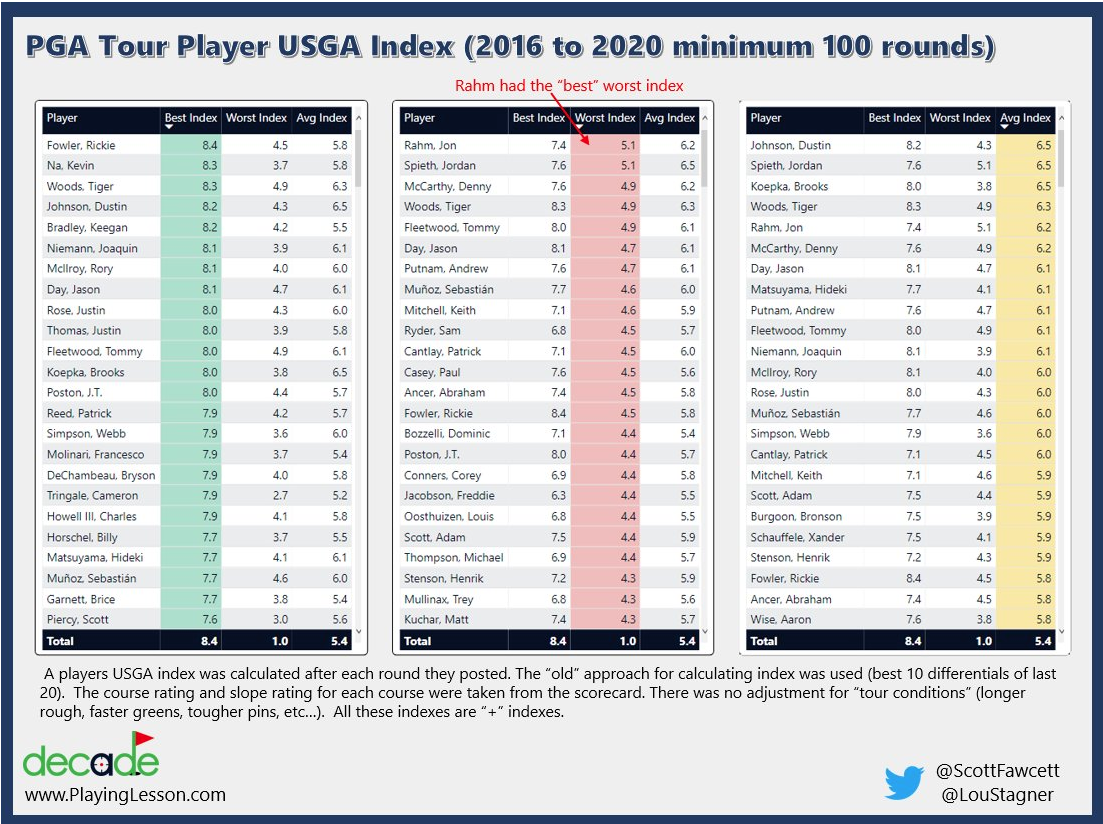
Want to know how good PGA professionals really are? The chart below shows their handicaps from 2016 to 2000. They’re pretty low.

To put plus handicaps into perspective, it is said that there is a greater difference between a 3 and a +3 that there is between a 3 and an 18.

If a plus handicap is a new idea to you, it works like this, roughly. Take the course rating and subtract the handicap. So if your local course is rated 70.0, and a pro’s handicap is +8, their expected score would be 62.

That’s not exactly how it works, but that gives you the general idea.

The average index is +5.4. The best index achieved as Ricky Fowler’s +8.4.

It all works out to the fact that they’re playing a different game than we are.

(Click to enlarge)

A Single-Digit Golf Swing

Want to see what the golf swing of a single-digit player looks like? Go to this post, the video shot in 2010, and take a look at how I was swinging when I played at that level.

It’s nice-looking swing, simple, effective. It doesn’t hit great shots, but it hits good shots, one after the other.

I look at this video often to remind myself that I don’t have to have breathtaking technique to play good golf.

I look at this video often to remind myself that this is how I play golf.

This swing is my golfing personality. There is no need to mess with it.

This swing works. All I have to do is this and I can play good golf.

When you get into an extended spell of playing well, hopefully because you have gotten unstuck and are now playing at a new level, make a video of yourself swinging.

I guarantee you will come back to it sometime later to remind yourself of how simple it all was, and how simple it needs to be now.

The Natural Placement of Your Hands on the Golf Club

NOTE: A Basic Golf Swing is now available that develops the comments below in full, and more, in both words and video.

—–

Golf instruction books speak of three orientations of the hands when taking a grip: strong (the Vs between your thumbs and forefingers point outside your trailing shoulder), neutral (the Vs point at your trailing shoulder), and weak (the Vs point at your chin).

These are grip categories, however. They should not be taken as actual ways to set your hands on the club. How you do that is an individual matter that should reflect the natural orientation of your forearms. *

Instructors often talk about the clubface getting out of alignment because the hands turned the clubhead, but they do no such thing because they can’t turn. It is the forearms that turn, carrying the hands with them. This is not a trivial distinction.

When the forearms start out in their natural position, they will stay there (unless you disturb them) and return the clubface to the ball square. If you address the ball with them out of position, they will return to their natural position during the first few feet of takeaway, very likely without your being aware of it. There goes your shot when it has just barely started.

Stand with your arms hanging naturally by your sides. Notice where the backs of your hands are facing. They must face the same way when you put your hands on the club, which in turn puts your forearms in their natural position.

If you have trouble with the clubface being either open all the time at impact, or closed, and have tried everything to fix it without success, consider that the only problem is with your grip. It’s not your grip, but someone else’s.

You might find as well that the swing feels kind of effortless because you are not forcing your arms to move in a way they don’t like. That’s not a bad thing!

* The only instruction books I have found that mention this point is the chapter on the grip in Al Geiberger’s book, appropriately titled, Tempo, and Phil Galvano’s Secrets of the Perfect Golf Swing.

Notes From a Round of Golf

To hit a good opening tee shot, look at your grip to be sure you have placed your hands on the club correctly. When you swing, make sure you apply good rhythm and tempo. Do just those two things and you should be O.K. Actually, do this before every swing for the first two holes while you’re getting settled in. Actually, do this all day.

Two hundred and sixty yards from the green? Put away the fairway wood. You’re going to take two shots to get there no matter what, so make them easy shots: two 8-irons, a 7 and a 9, etc. Unless you are really good with them, I don’t know why you would hit a fairway wood from the fairway anyway.

Do you have a five-foot putt that looks like it will run straight into the hole? Walk to about thirty feet away and look again. Now you can see that the green is a little higher on the right than it is on the left, and only from back there can you see it. A putt that looked straight really breaks left, and now you know.

You know how some of the pros take the club part way back and look at the clubface? They’re looking to see if the face turned out of square in their takeaway, which is easy to do. Checking yourself this way might be a good habit for you to adopt.