Category Archives: golf swing

The Right Way to Create a Golf Swing

[August 2019. the right way to create a golf swing is found at The Hands Lead the Clubhead – IV.]

There is a basic approach to the swing that many golfers take because it seems so obvious to do. And yet it is the wrong approach and is what prevents them from doing with the ball what they set out to achieve.

Percy Boomer, in his essential book, On Learning Golf, calls it Golf Bogey No. 1. It is “the natural urge to act in an obvious way to achieve the desired result.”

He takes a phrase from F. Matthias Alexander, who calls it end-gaining. This is thinking about what the desired result to the exclusion of the best way to attain that result.

How does this relate to the golf swing? It comes out as making movements which we feel will put the ball in the fairway off the tee, or on the green from the fairway. And they never work.

In golf, Boomer points out, the obvious way (to us) is seldom the right way. Very little of the golf swing is natural. The golf swing is a learned art, which must be trusted to deliver the desired result.

This is why you see so many weird-looking swings out there. People are trying to hit the ball with the club in a way they think will work and it does just often enough that they mistake luck with skill.

Golf is not about hitting the ball. It’s about making the right swing with a ball in the way.

You don’t play well by thinking about what you have to do to hit the ball in a certain direction or a certain distance. You play well by thinking about how to make the right swing. You must concentrate on the means, not on the end.

So when you are on the practice tee and not hitting the ball too well, do you say to yourself, “Maybe if I try this,” and two indifferent shots later you think, “How about trying this?”, getting yourself deeper and deeper into trouble because you’re trying to guide the club into the ball. That’s end-gaining.

Instead of being in control of where the ball goes, we must be in control of what our swing does. Then, when we sweep the club through the ball in the proper way, it will go where it is supposed to go.

What then is the proper way to swing the club? It’s most likely what your pro taught you in your last lesson (you do take lessons, don’t you?). Learning my Six Fundamentals won’t hurt you, either.

Let me try to seal the argument this way. Do you remember the shots you made, and I know you’ve made them, that went long and high and straight and it was because your mind went blank for a moment and you just swung the club? You weren’t thinking about how to make the ball go to a certain place, it just went there?

That’s what I’m talking about. If you can take that momentary lapse in concentrating on the wrong thing, and make that your habit, and combine that with good technique, good golf will be yours.

My Annual Swing Rebuilding Project

Every year, when golf season is over, I work on my swing, starting over from the start. I go through my bag, from 9-iron to driver.

If you have seen some of my recent videos on YouTube, you know I have a little practice station in my back yard. I went out to my practice mat with my 9-iron, and hit just that club. Over and over. When I get 3 out of 5 shots just right consistently, and the other two aren’t bad, I’ll move up to the 8-iron. And then one club at a time when I’m ready for it.

I probably won’t be up to the driver before the rainy season hits. We’re having warm weather with clear skies, but in Oregon that won’t last too long this time of year.

I’m dedicating myself to building the Six Fundamentals into every swing. I review them all before I hit a ball. One thing I’ve added is to sweep the club through the ball, and not to hit at it. That is making a world of difference.

Aside: If you get the latest Golf Digest, with Beef Johnston on the cover, you’ll find an article inside by Bob Toski about swinging with your hands, and not with the big muscles that is so much in vogue nowdays. This is exactly what I said in SF. I advise you to get this article and read it carefully. A lot of what pros say about the risks of your hands being in charge of your golf is baloney.

But back to my program. If you want to be better ball striker, take the swing you have and work your way through your bag, one club at a time, demanding a quality hit with every ball before you move up. Really. This works.

The other part of getting my game back in order is hitting two to four-foot putts in my back room. I am getting REAL good at these. Sinking these putts is how you avoid three-putt greens or not getting up and down.

Six Fundamentals Revisited

My multimedia essay on the golf swing, Six Fundamentals of the Recreational Golf Swing, I outlined six principles that lead to a better swing and better ball-striking.

Last week I posted a link to a video by Vivien Saunders where she presents a different way of looking at the swing.

Instead of saying, Do these things with your body and you will swing the club correctly, she turns that around. Swing the club correctly and the body will respond correctly.
The club tells the body how to move, not the body tells the club how to move.

Let’s look at Six Fundamentals from this point of view to see how they are still relevant.

1. The First Fundamental is about rhythm and tempo (my favorite subject). Only if these two points are under control will you be abel to feel how the club is supposed to move, and can you let the club guide your movement.

2. Swing with both hands. Definitely you want to do this. The club transmits its directions to the body through the hands. If you start emphasizing the right hand (left hand, if you play left-handed) you’re telling the club what to do.

3. Take the club straight back to control. You still have to aim your swing, and if you take the club back only as far as the control point, you don’t introduce extraneous movment to the cub that it has to recover from.

4. The right knee moves left (or left knee moving right, for lefties). This is the essence of the pivot, which you will do correctly if you are letting the club be in control. A sign that you are not doing that is if your knee does not move and you hang back.

5. The hands lead the clubhead through impact. This the chicken and the egg part of the swing. You have to do this for the club to move correctly, and if the club moves correctly, you’ll be doing this. This is the moment of truth, your pass-fail exam.

6. Swing straight through toward the target. Why? Because that’s where the club wants to go. Just follow it there.

To sum it up, Fundamentals One to Three are what allow you to let the club guide you, and Fundamentals Four to Six are what happens if you do.

This new way of thinking about these Fundamentals might help you apply them to your swing more effectively.

Finally, here’s a tip. When you watch a good golfer’s swing, do not watch what they do with their body. Watch the golf club.

In this video, I‘m not asking you look like I do when I swing the club, but to move the club like I do when I swing. Big difference.

How the Golf Swing Really Works

If you haven’t already heard of her, I would like to introduce you to Vivien Saunders, a great teacher who lives in the U.K.

In this video, she turns around everything you have heard about how to swing a golf club.

Swinging a golf club is not what happens when you do the right things with your body. It is what happens to your body when you swing the golf club correctly.

Watch this.

Now you don’t have to watch the Golf Channel anymore.

The Essence of Golf (Advice)

If I were to give recreational golfers advice on what would do the most good to get them hit the ball better, I would say these things:

Golf Swing

Get a grip that fits your body. This is two things. A good grip is one that has a chance of success. Many rec golfers I see play with a grip that is too strong or doesn’t leave the hands working together. See a pro, get a lesson, to be sure about yours. Also, you might have a fine grip, but it doesn’t go with your swing. If you have a neutral grip and a slice swing, that’s trouble.

Learn the correct rhythm, and the tempo that is right for you. Rhythm is the same for everyone. This blog post shows you what rhythm is and how to get it. Tempo is different for everyone. Yours is probably too fast. Try this post to find your best tempo.

Your hands must lead the clubhead coming into the ball. Most of you do the opposite, because you’re trying to hit the ball with your right hand. This is an easy idea to understand, but difficult to execute because our “hit” instinct is so strong. See this video.

Pitching and Chipping

This one is really simple. First, get lessons on how to hit these shots. One lesson for each shot. They are their own kind of shot and need to be learned that way.

Then, hit them using the iron method — one swing, different clubs. For pitching, you really need two swings, of different length, but for chipping, only one. Calibrate each swing and you can’t miss.

Practice your standard strokes A LOT so they don’t slowly drift on you and make you wonder why you aren’t getting the ball close anymore.

Putting

I commonly spend an hour on the practice green chipping and putting, mostly putting. I see other rec golfers come on, putt for about ten minutes, and leave. Who is going to become the better putter?

Use a pendulum stroke that moves in one unit from your shoulders to the clubhead. Do not let your wrists get involved.

Find an alignment spot on the green in front of your ball and hit the ball right across it.

Practice short putts, from two and three feet, A LOT. Hit these putts with authority. Do not finesse them into the hole.

Calibrate your stroke so you can hit to fifteen feet, twenty-five feet, thirty-five feet, and forty-five feet at will. Practice these stokes at a hole to maintain them, and to learn how to add or take off a few feet because of differing green speeds.

That takes care of ninety-five percent of golf. Learn the other things, bunkers, uneven lies, wind, a multitude of short game shots, after you have mastered the material above.

Ben Hogan’s Three Right Hands

There’s a guy I play golf with occasionally who is in his 50s and new to the game. He’s small, but strong. His swing is, wind up the upper body and swing through as hard as you can with your shoulders and arms. When he connects, it’s really impressive. The other ninety percent of the time, it’s not.

He told me once that he read Ben Hogan’s book (Five Lessons) and mentioned the part where Hogan said he wished he had three right hands. Having read that book so much I almost have it memorized, I agreed that Hogan did say that.

I think my friend interpreted that as a green light to hit the ball as hard as he could with his right hand. That sure looks like what he’s trying to do.

What I didn’t say, because I don’t give unsolicited advice on the golf course, is my friend needed to read the whole sentence rather than just that part.
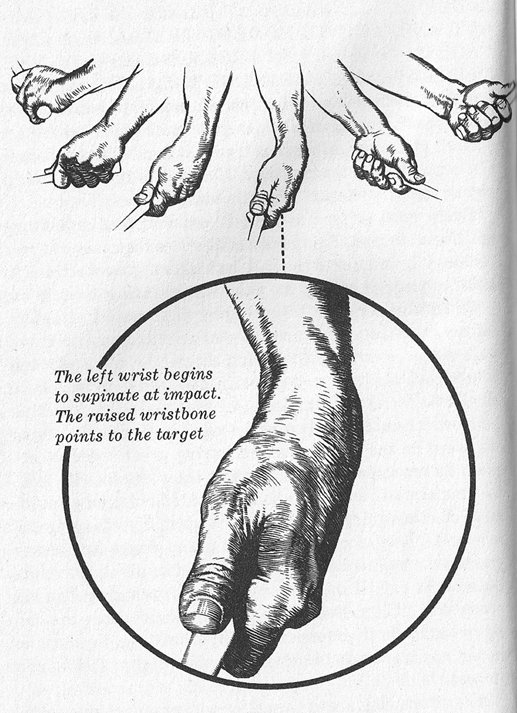
 Hogan at that point (p. 101) was talking about the left wrist. I won’t give you the entire quote, but he said,

“…the left hand will not check or interrupt the speed with which your clubhead is traveling. There’s no danger either that the right hand will overpower the left and twist the club over. It can’t. As far as applying power goes, I wish I had three right hands!”

That’s it. You can hit as hard as you want to with your right hand IF THE LEFT WRIST IS IN THE PROPER POSITION (illustration below).

Hogan-left-wrist-action

Hogan was not saying to hit the ball as if you had three right hands, period. There is a catch, and the catch is the shape of the left wrist.

The right hand turning over the left was my problem exactly for many years. I solved it by changing my grip and by giving my hands less responsibility through impact.

What I have is a flat left wrist at impact. Having that wrist bend outward like Hogan showed is beyond my ability. If you can get your left wrist flat (Hogan) and facing the target (Trevino) at impact, you’re way ahead of the game.

But back to the book. Hitting hard only makes sense if you are sure you can keep the clubface aligned while you’re doing it. Hogan showed you in Five Lessons how he did it.

A shorter way of saying it is, square first, hard second.

Swing Through to the Finish

If you get a chance to go to a professional golf tournament, men’s or women’s, go to the practice ground and watch the golfers warm up. You will be stuck by the apparent ease with which they swing the club.

No one is pounding the ball. Everyone is just swinging the club. There is no hint of forcing the shot in any way. You could watch this all day.

Here’s the difference between us and them in a nutshell. We think the swing ends when the ball is struck. They think the swing ends when the club stops moving at the finish. That difference makes all the difference.

Golf swing instruction in almost any book you read, instructional videos and Internet videos you see, breaks down into four areas: pre-swing fundamentals, backswing, downswing, and impact. There is little, if any, instruction on the finish.

So, I’m going to give you some. It’s in the form of a drill that focuses on the finish.

Make shortened swings with your driver, no ball, in this way. Take the club halfway back and swing smoothly and slowly (emphasis on “slowly”) to a full finish, just like you see the pros do. When you get there, hold that pose for a few seconds to let your mind absorb the process of your swing leading you to this place.

Repeat, repeat, repeat. This drill makes you aware that the finish is a part of the golf swing, not residue of what came before.

When you play, instead of taking your stance and thinking about how you’re going to hit the ball, send your mind to the end of the swing, and beyond that. Let impact be another thing you breeze right through on the way to your finish.

In a sense, it feels like you’re giving up control of the shot. What you’re doing is getting more control. Try it.

Hit Down With Your Irons — Not

Hit down on the ball. You can’t get away from this advice. It’s like bad weeds in your garden that you spray and dig up and think you’ve gotten rid of them and a month later there they are again.

Why do you keep hearing this nonsense? Because it kind of makes sense.

The club is way up there in the backswing and it has to come back down to get to the ball, so in that sense you are hitting down on the ball.

But that is not the sense that too many golfers interpret the words. They think it means to be hitting down steeply. That is the sense that leads to frustration because they end up chopping down.

I’ll admit if you hit down like that, you can get some pretty good shots out of the effort with the short irons.

But with the lesser-lofted irons, it doesn’t work so well. Forget about it with your fairway wood, and don’t even mention your driver.

Instead of hitting down, think about the spot where the club travels level with the ground, because it does that eventually. With an iron, it’s then just a matter of addressing the ball so that it lies a little bit behind that spot, and a ball on a tee is positioned a little ahead of that spot.

That’s all there is to it.

Remember “13 clubs, 1 swing” from a few months ago? Remember about hitting the ball forward?

There’s no “hitting down” in any of that. Don’t hit down. Hit forward.

Trust Your Golf Swing

Trust your swing. You hear that phrase a lot from professional golfers. It means to rely on what you have practiced and play with what you’ve practiced instead of monitoring technical points as you play. That last part is still practice. Practice is over. It’s time to play.

I’ve heard Olympic athletes say that, too. They practice their skill over and over so when it’s time to compete they just do what they practiced. They don’t think about it any more. They just do it.

Recreational golfers, I think, would find this difficult to do. Very few of us (including me) practice enough that our positive habits become so ingrained and that we can rely on them without further reference.

In our game, when we address the ball, we’re often still not sure if this thing is going to work. So we decide to help it along.

There, my friend, is the worst mistake we can make on the golf course. That extra little thing, which is no more than a last-second guess, almost always makes things worse.

You might find instead that your best shots came when, by some lucky accident, your internal voice turned off for a moment and you just swung the club. What you had practiced is what came out and you got a great shot out of it.

When got to the ball for the shot after that one, you started to wonder what you did last time that made that shot so great so you began sorting through technical points, when all that really happened is you just SHUT UP for a change and played golf.

Leave all the technical stuff on the practice tee. On the course, concentrate on getting the ball into the hole.

Build Your Swing Around Your Wedges II

[Revised July 7, 2019.]

A few years ago I started advising anyone who would listen that this is the way to build a competent, consistent golf swing: hit wedges, lots of wedges. Take the club back halfway, swing through to a full finish.

This is my second post on the subject, hence the quantifier in the title. But the notion is so important that I don’t want to let it be one and done because you might never find that first post. So I’m posting the idea again.

Actually, I should post it every other week, it’s that important, but that probably would create a different impression in your mind than emphasis, so I won’t.

There are four reasons why this is such an important practice.

1. You learn how the timing of your swing works–how all the parts work in the right order and what it feels like when they do.

2. You learn to relate distance to tempo rather than effort.

3. You learn how to hit the ball on the center of the clubface. Your score is directly related to how often you do this.

What you learn with your wedge applies to every other club in the bag. And because it is so easy to hit the wedge, you will transfer that feeling of ease to every other club and hit shots with them just as confidently as you do with the wedge.

Here’s how to do it. First, set aside twelve balls out of your bucket. Take out your sand wedge. Make four practice swings. Swing halfway going back, and follow through to a full finish. After the four such swings, pull a ball forward hit it, using the same swing you made those four times. Go through the entire rest of the bucket in this way.

Do not rush the practice swings. Take a few seconds after each one to absorb the feeling of what you just did. You’re training your mind, and that won’t happen if you don’t give it a chance to soak in what it just did.

When you have emptied your bucket, take those ten of the balls you set aside and go through your bag, hitting each club, going from pitching wedge to driver, one swing each, a full swing, with the same timing and tempo that you used with all those sand wedges you hit. During this drill you will realize the fourth very important point:

4. You swing your driver just like you do your 9-iron, and you swing your 9-iron just like you do your driver. Ditto for every club in between.

You have two balls left. End the session by going back to the start: four half-swings with a sand wedge, hit one ball. Repeat.